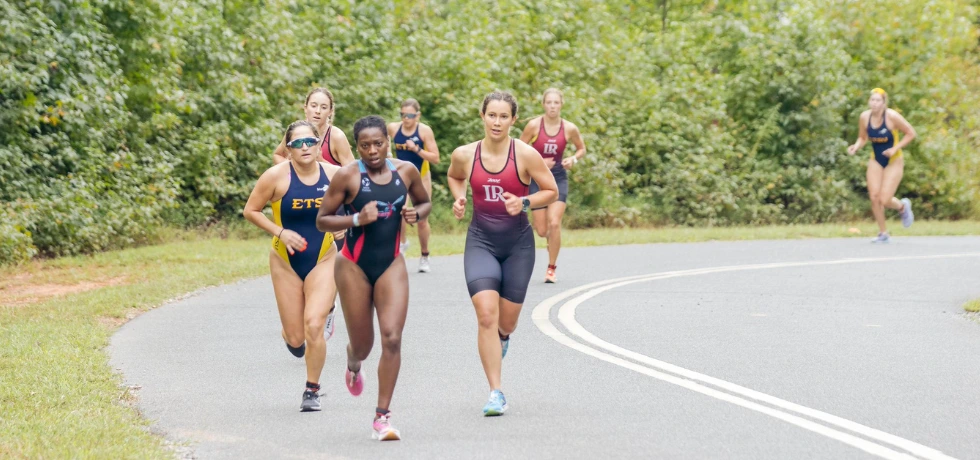
Women’s triathlon remains stuck in NCAA Emerging Sport purgatory. It has languished there since 2014 while women’s wrestling has already achieved NCAA championship status and women’s stunt will see its first NCAA championship projected for spring 2027. Next year stunt will likely join five other programs that have earned NCAA championship status through the Emerging Sports for Women program: rowing (1996), ice hockey (2000), water polo (2000), bowling (2003) and wrestling (2025). The 2025 update on women’s triathlon’s path to NCAA Championship Sport status feels eerily familiar to 2023 and 2024.
Spearheaded by USA Triathlon (NGB) Chief Sport Development Officer Tim Yount, 11 years have passed, over $4 million spent, with overly optimistic updates that stretch the bounds of the sponsoring organization’s credibility. Of significant concern is recent NGB guidance which positions its commercial interests ahead of the participating institutions, their athletes and the overall goal of making triathlon an NCAA championship sport.
2025 NCAA Triathlon Update: By The Numbers.
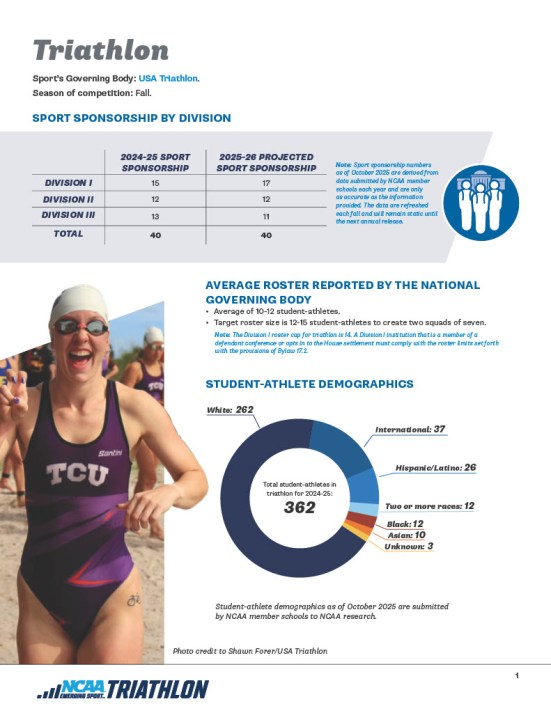
- 2025 School Count. 39 Schools. The La Salle University addition in 2025 partially offset the departure of both Calvin University & St. Thomas Aquinas College. The net result was a contraction of one school. In March 2025, Long Island University (LIU) announced the launch of both women’s triathlon and women’s flag football programs for Fall 2025. Jean Anne Smith, LIU Senior Director/Senior Woman Administrator, confirmed that the original plan has experienced divergent outcomes with flag football rapidly moving forward due to significant support while plans for triathlon are on the back burner.
2. 2025 Roster Check: 320 Athletes. Data taken directly from participating institutions’ rosters yields 320 athletes versus 345 in the previous year or a 7% YoY decrease. The athlete count is materially different from the 362 number reported via the NCAA Sports Sponsorship and Participation Rates Database. Also included in the database is 1738 participants for women’s wrestling & 1231 participants for women’s stunt.
3. 2025 Median (7) & Average (8.2) Roster Size. Both of these numbers are significantly lower than the average 10-12 average student-athletes reported to the NCAA. That statistic appears to be a misnomer and better describes a range and not an average.
4. Minimum Roster Size Concerns At 4 Institutions. Our understanding is that the minimum roster size requirement is 4 student-athletes. The current rosters indicate that these institutions were not able to field the minimum number of participants.
- Greensboro College (2 athletes)
- Chicago State University (3 athletes)
- Emmanuel University (3 athletes)
- Guilford College (3 athletes)
5. $880K NGB Funding (2024). Based on the NGB’s latest available 2024 tax return (page 44-45), $880K was spent supporting institutional and athlete funding in 2024.
| $880K NGB Funding (2024) | |
|---|---|
| Amount | Institution |
| $110,000 | University of Indianapolis |
| $65,000 | La Salle University |
| $50,000 | Gallaudet University |
| $40,000 | Duquesne University |
| $40,000 | Roberts Wesleyan University |
| $35,000 | Concordia University Wisconsin |
| $25,000 | Northern Kentucky University |
| $25,000 | Warren Wilson College |
| $10,000 | Calvin College |
| $10,000 | Chicago State University |
| $470,396 | Athlete Tuition/Stipends (23 athletes) |
| $880,396 | Total |
Suggestions For The Future
1. Clear Is Kind. Gaining NCAA Championship Status means the financial burden of the season ending championship passes from the institutions to the NCAA. In the case of women’s wrestling it is a $1.7 million per year investment. In a November 2022 article, NCAA Triathlon: What’s Next, Tim Yount speculates on a number approaching 70 varsity women’s programs in 5 years, i.e. 70 programs by 2027, and is quoted as saying “We’re gonna keep blowing it up. We’re gonna keep moving.” The “mission accomplished” banner was hung in 2022, 2023, 2024 and 2025 without actually meeting the NCAA Championship criteria. Setting reasonable guidance relative to a budgetary relief is the only way to get and keep credibility with athletic directors, who are often in those roles for extended periods, and have good memories.
2. Recognize The Competition From Other Emerging Sports: Women’s Wrestling, Stunt, Flag Football. Our last update featured women’s wrestling achieving NCAA Championship status becoming the first emerging sport in a generation to make the leap. It appears that stunt is up next with flag football following closely. The profiles of these sports make it an easy bet for tuition seeking institutions looking to attract a new generation of student-athletes to campus.
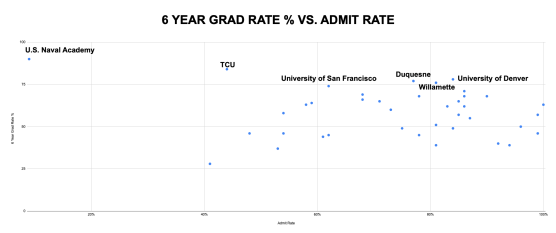
3. Onboard Selective & Highly Selective Schools. With an admission rate of 9%, the US Naval Academy is a wonderful example of a highly selective institution that could interest families of high achieving student-athletes. Unfortunately it is the only example. In fact, per the latest US News & World Report, the highest rated university sponsoring women’s triathlon is Texas Christian University at #97 and the USNA is the only Top 100 liberal arts college among this set. The initiative will continue to struggle without meeting the needs of parents looking for selective and highly selective schools.
4. Provide A Welcoming Athlete Experience. Since 2019, Cal Tri Events or its predecessor in Virginia, CMS, has been fortunate to host at least one women’s varsity race each year at Cal Tri Charlottesville. Held near Labor Day, it features a 50 meter pool suitable to a wide range of athletes. Coaches like Bob Hepler, from Eastern Mennonite University, who credits the race with helping him keep and attract first-time triathletes compares it favorably to the most recent eastern regional championship where D3 athletes were once again lapped out in the competition due to poor course design not focused on the athlete experience. Athletes dismount their bikes and are forced to walk back to transition as the final act of their season and in some cases their career. We have to do better.
5. Place Athletes Before The NGB’s Commercial Interests. In 2024 there were approximately 1,000 USAT insured triathlons and 300+ non-NGB insured triathlons including Cal Tri Charlottesville described above. On September 5, 2025 a poorly received directive from the NGB to currently participating institutions attempted to assert NGB control over institutional choices by forbidding participation in any non-NGB insured races. Fortunately, the coaches association quickly clarified that USAT has no authority to dictate school choices. In a market where it is harder and harder to find suitable races, the NGB’s eagerness to protect its insurance revenue stream is at odds with needs of partner institutions who are looking for desirable race options with a long track record of success for their student-athletes.
6. Feed It Or Forget It. Per the NGB, $4 million has been spent to date with $880K spent in the most recently available tax year. A thorough strategic review is needed to determine if a strategy put in place in 2014, before a 46% drop in triathlon participation, is still viable and if the current leadership has the vision and access to the resources that get this initiative over the line. Does an NGB with a net income of -$4.4 million from 2022-2024 have the resources to make that happen? We certainly hope so but if not, there is no shortage of club coaches and club athletes ready for a bit of largess from the NGB.
Editorial Note: For the previous NCAA Triathlon update, the NGB was afforded a courtesy review before publication. Unfortunately, information from that article made its way outside the NGB and generated an unfortunate response from a participating institution head coach. Fortunately, the school’s athletic director was quick to remedy. This article and future articles will not be shared with the NGB until proper assurances are in place that information will be handled properly.
The below interactive chart presents comparative data about the institutions with active NCAA varsity triathlon teams in the U.S., a tool that has resonated with a broader community. The information reflects both triathlon program-specific insight and institutional metrics associated with the relative health of the organization.
2025-2026 Collegiate Triathlon Snapshot
Scroll horizontally to view the full table.
| College 2024-2025 Collegiate Triathlon Snapshot | Location | NCAA Division | 2026 US News Best Colleges National Ranking | Endowment (million) | Endowment / Student | Women's Roster (2025-26) | International Athletes | International % Of Roster | Admit Rate | Grad Rate % (6 year) | Undergrads | Men | Women (<50% bold) | Athletics Expenses |
|---|---|---|---|---|---|---|---|---|---|---|---|---|---|---|
| Arizona State University | Tempe, AZ | 1 | 117 | 1290 | 21,662 | 12 | 6 | 50% | 90% | 68 | 59551 | 30408 | 29143 | $126,892,086 |
| Black Hills State University | Spearfish, SD | 2 | Unranked | 33 | 20,913 | 8 | 1 | 13% | 94% | 43 | 1552 | 537 | 1,015 | $6,195,391 |
| Cal Poly Humboldt | Arcata, CA | 2 | Unranked | 42 | 8,592 | 13 | 2 | 15% | 99% | 46 | 4888 | 2,171 | 2,717 | $7,902,578 |
| Chicago State University | Chicago, IL | 1 | Unranked | 8 | 8,155 | 3 | 1 2 1st year w/o bio | 33% | 41% | 28 | 981 | 321 | 660 | $8,264,373 |
| Coe College | Cedar Rapids, IA | 3 | Liberal Arts 126 | 103 | 83,536 | 5 | 1 | 20% | 71% | 65 | 1233 | 599 | 634 | $3,631,703 |
| Colorado Mesa University | Grand Junction, CO | 2 | Unranked | 50 | 7,817 | 12 | 2 | 17% | 81% | 39 | 6396 | 2988 | 3408 | $14,342,387 |
| Concordia University Wisconsin | Mequon, WI | 3 | 329 | 116 | 60,228 | 7 | 0 | 0% | 68% | 66 | 1926 | 799 | 1127 | $3,633,573 |
| Delaware State University | Dover, DE | 1 | Unranked | 43 | 10,570 | 6 | 4 | 67% | 62% | 45 | 4068 | 1399 | 2669 | $15,986,336 |
| Drury University | Springfield, MO | 2 | Unranked | 96 | 71,111 | 10 | 5 | 50% | 59% | 64 | 1350 | 641 | 709 | $9,760,855 |
| Duquesne University | Pittsburgh, PA | 1 | 169 | 565 | 109,687 | 15 | 4 | 27% | 84% | 78 | 5151 | 1897 | 3254 | $28,802,065 |
| East Tennessee State University | Johnson City, TN | 1 | 301 | 88 | 10,219 | 9 | 2 | 22% | 87% | 55 | 8611 | 3371 | 5240 | $19,811,089 |
| Eastern Mennonite University | Harrisonburg, VA | 3 | Unranked | 38 | 49,287 | 6 | 0 | 0% | 100% | 63 | 771 | 314 | 457 | $2,412,941 |
| Emmanuel University | Franklin Springs, GA | 2 | Liberal Arts 135 | 2 | 2,857 | 3 | 2 | 67% | 53% | 37 | 700 | 387 | 313 | $11,070,770 |
| Gallaudet University | Washington, DC | 3 | 198 | 192 | 233,293 | 8 | 0 | 0% | 61% | 44 | 823 | 394 | 429 | $3,037,053 |
| Greensboro College | Greensboro, NC | 3 | Unranked | 26.5 | 41,601 | 2 | 0 | 0% | 92% | 40 | 637 | 411 | 226 | $2,664,408 |
| Guilford College | Greensboro, NC | 3 | Liberal Arts 172 | 85 | 85,772 | 3 | 0 | 0% | 84% | 49 | 991 | 481 | 510 | $3,148,264 |
| Hampton University | Hampton, VA | 1 | 273 | 351 | 112,069 | 5 | 0 | 0% | 48% | 46 | 3132 | 1003 | 2129 | $15,830,182 |
| King University | Bristol, TN | 2 | Unranked | 37 | 42,141 | 4 | 0 | 0% | 54% | 46 | 878 | 348 | 530 | $7,501,568 |
| LaSalle University | Philadelphia, PA | 1 | 257 | 83 | 48,824 | 7 | 3 | 0% | 86% | 62 | 1700 | 637 | 1063 | $18,013,745 |
| Lenoir-Rhyne University | Hickory, NC | 2 | Unranked | 137 | 105,466 | 18 | 9 inc data | 50% | 81% | 51 | 1299 | 595 | 704 | $12,573,705 |
| Millikin University | Decatur, IL | 3 | Unranked | 102 | 72,909 | 7 | 1 | 14% | 54% | 58 | 1399 | 650 | 749 | $4,520,764 |
| Navy (U.S. Naval Academy) | Annapolis, MD | 1 | Liberal Arts 3 | 518 | - | 8 | 1 | 13% | 9% | 90 | 4465 | 3144 | 1321 | $68,100,000 |
| Newberry College | Newberry, SC | 2 | Unranked | 17 | 11,797 | 5 | 4 | 80% | 75% | 49 | 1441 | 771 | 670 | $11,477,719 |
| North Central College | Naperville, IL | 3 | Unranked | 119 | 51,183 | 7 | 0 | 0% | 58% | 63 | 2325 | 1130 | 1195 | $5,530,314 |
| Northern Kentucky University | Highland Heights, KY | 1 | Unranked | 120 | 17,902 | 5 | 0 | 0% | 96% | 50 | 6703 | 2777 | 3926 | $13,467,033 |
| Queens University | Charlotte, NC | 1 | Unranked | 154 | 116,490 | 9 | 8 inc data | 89% | 68% | 69 | 1322 | 494 | 828 | $26,372,595 |
| Roberts Wesleyan University | Rochester, N.Y. | 2 | Unranked | 33 | 35,069 | 4 | 2 | 50% | 78% | 68 | 941 | 352 | 589 | $4,624,282 |
| Texas Christian University | Fort Worth, TX | 1 | 97 | 2440 | 227,654 | 12 | 7 | 58% | 44% | 84 | 10718 | 4053 | 6665 | $141,889,741 |
| Trine University | Angola, IN | 3 | Unranked | 49 | 21,185 | 10 | 0 | 0% | 85% | 65 | 2313 | 1455 | 858 | $6,157,867 |
| University of Arizona | Tucson, AZ | 1 | 127 | 1200 | 35,166 | 10 | 6 | 60% | 86% | 68 | 34124 | 14668 | 19456 | $138,959,027 |
| University of Denver | Denver, CO | 1 | 117 | 990 | 172,144 | 7 | 2 | 29% | 77% | 77 | 5751 | 2563 | 3188 | $51,534,887 |
| University of Indianapolis | Indianapolis, IN | 2 | 301 | 123 | 41,582 | 10 | 1 | 10% | 73% | 60 | 2958 | 1177 | 1781 | $17,373,884 |
| University of San Francisco | San Francisco, CA | 1 | 110 | 503 | 90,778 | 13 | 6 | 46% | 62% | 74 | 5541 | 1915 | 3599 | $27,348,074 |
| University of South Dakota | Vermillion, SD | 1 | 283 | 327 | 71,852 | 6 | 2 | 33% | 99% | 57 | 4551 | 1575 | 2976 | $21,548,929 |
| Wagner College | Staten Island, NY | 1 | Unranked | 96.5 | 62,662 | 6 | 6 | 100% | 83% | 62 | 1540 | 614 | 926 | $22,415,885 |
| Warren Wilson | Swannanoa, NC | 3 | Liberal Arts 183-201 | 56 | 78,103 | 5 | 0 | 0% | 78% | 45 | 717 | 246 | 741 | $1,269,979 |
| Willamette University | Salem, OR | 3 | Liberal Arts 77 | 307 | 203,311 | 12 | 0 | 0% | 81% | 76 | 1510 | 591 | 919 | $3,997,628 |
| Wingate University | Wingate, NC | 2 | 373 | 111 | 45,792 | 19 | 14 | 74% | 85% | 57 | 2424 | 1023 | 1401 | $12,073,396 |
Key:
- 2026 US News Best Colleges National Ranking. Sourced from 2026 US News and World Report Best Colleges. Each school is categorized- and subsequently ranked- as either a national university or liberal arts college and specified accordingly here.
- Endowment (million). A college endowment is an invested compilation of donor funds that stabilizes and supports institutional responsibilities that provide an annual rate of return to meet current operational needs, CASE. Source: DataUSA, the most comprehensive website and visualization engine of public US Government data.
- Endowment/student. A metric that measures the amount of an institution’s endowment assets available per enrolled student. *Column L/Column E*
- Women’s roster. Total number of female triathletes listed on individual institutional team websites.
- Admit Rate. The percentage of students applying for full-time, first year undergraduate admission who are admitted to the institution. Source: College Navigator
- Grad Rate. The portion of undergraduate students who receive their degree within six years of enrolling full-time, the most generous rate among this metric. Source: Niche
- Athletics Expenses. Total annual expenses per team for the institution. Source: US Department of Education Equity in Athletics Data Analysis